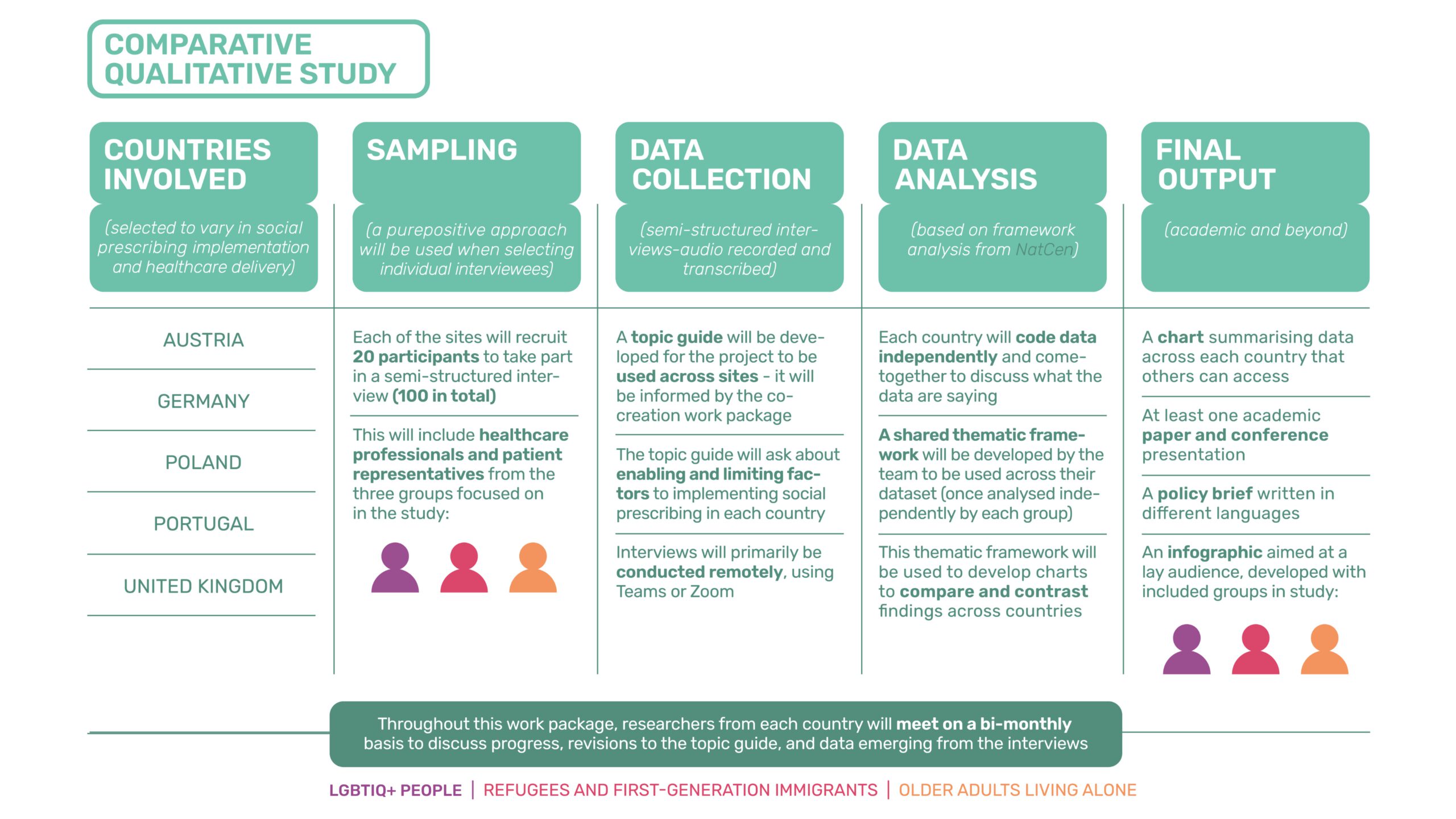
What is the qualitative study addressing and how?
As part of the overall SP-EU project, a qualitative work stream is being conducted to explore the question: What are the enabling and limiting factors associated with implementing social prescribing across different European countries, from the perspective of key stakeholders? It involves data collection, through semi-structured interviews, with a range of stakeholders – people receiving, delivering, managing, and funding/commissioning social prescribing. Data will be collected across five countries – Austria, England, Germany, Poland, and Portugal. Each country will conduct interviews with approximately 20 stakeholders. Data will then be compared and contrasted across countries, using framework analysis.
Why do we, as a work stream, feel this qualitative study is an integral part of the SP-EU study?
Qualitative research is an approach that can explore experiences and help with understanding meanings. Hence, this part of the SP-EU will illuminate findings from the trial and provide an insight into how social prescribing is perceived in different countries. It will support us in understanding how context shapes people’s encounters with social prescribing. In addition, it will surface issues related to accessing social prescribing for underserved groups, which can be considered when designing and delivering this approach to ensure its provision is equitable and accessible. This will support the optimisation of social prescribing in the future. Findings will highlight structural and sociocultural factors affecting engagement with social prescribing and how these differ across countries; this will support the delivery of more equitable access for the groups in question and for other marginalised cohorts. Each country (ranging from those that have implemented social prescribing on a national scale to those just commencing its implementation) has the potential to learn from each other.
- Read our newest publication
Members of the team

Stephanie Tierney is an Associate Professor at the University of Oxford, United Kingdom.
“The opportunity to share experiences of social prescribing across European countries is an exciting prospect; working with colleagues from a range of backgrounds. We have the chance to learn from the implementation of social prescribing in different contexts, and to understand how it shapes people’s encounters with this non-medical approach to supporting health and well-being.”

Debra Westlake is a Senior Researcher at the University of Oxford, United Kingdom.
“I’m looking forward to learning from colleagues in other countries about what social prescribing means in their contexts and to the communities they work with. Understanding these different settings—and the barriers to engagement among underserved populations—will be vital for shaping how social prescribing develops internationally.”

Daniela Rojatz is a Senior Health Expert at the Austrian National Public Health Institute, Austria.
“I am looking forward to the opportunity to gain insight into the perception and implementation of social prescribing in different countries and to jointly uncover similarities and differences. A deeper understanding of access to social prescribing and any obstacles to it is another important step towards a more equitable healthcare system.”

Kerryn Husk is a Professor at the University of Plymouth, United Kingdom.
“Social prescribing has been implemented at scale in many countries around the globe, however often such pathways risk perpetuating or exacerbating existing inequalities and not maximising the potential for those most in need. I am excited that the qualitative component of the SP-EU trial will generate rich descriptions of how members of groups often left behind in terms of health services engage with social prescribing pathways, which will help us understand the detail of how we might do things better in the future.”

Donata Kurpas is a Full Professor at Wroclaw Medical University, Poland, and the National Coordinator of the SP-EU project.
“I look forward to exploring how the qualitative insights emerging from diverse European contexts can help us understand not only the mechanisms but also the deeper meanings and values underlying social prescribing. This work stream provides an opportunity to capture the voices of stakeholders across different health systems and cultural settings, enabling us to design more context-sensitive, equitable, and sustainable models of social prescribing within primary care.”

Ana Gama is an Assistant Researcher at NOVA National School of Public Health, Portugal.
“I’m excited to work together with colleagues from other countries to uncover the stories and perspectives that shape social prescribing across Europe and bring depth and context to the data from the SP-EU trial. By listening to those who live, deliver, and design these services, we can better understand what helps or hinders their impact in real-world settings. This insight is essential for making social prescribing more equitable, accessible, and responsive to people’s needs.”

Sónia Dias is a Full Professor at NOVA National School of Public Health, Portugal, and the National Coordinator of the SP-EU project.
“Social prescribing is gaining momentum worldwide, but it is essential that these initiatives genuinely promote inclusion and equity. The qualitative component of the SP-EU trial will generate rich insights into how diverse stakeholders — including service users, practitioners, community organisations, and policymakers — engage with social prescribing pathways in different contexts, with particular attention to those often left behind. By comparing perspectives across health systems, we aim to unlock obstacles, opportunities, and pathways for enhancing implementation, supporting the creation of more equitable, cohesive, and resilient societies, and ensuring the sustainability of health systems.”

Juliane Köberlein Neu is a Professor at the University of Wuppertal, Germany.
“I look forward to deepening our understanding of how social prescribing can contribute to more person-centred and sustainable healthcare. By learning from diverse European contexts, we can identify strategies to ensure that social prescribing reaches those who can benefit most.”

Trutz Bommhardt is a PhD Candidate at the University of Wuppertal, Germany.
“I’m eager to explore how social prescribing can be sustainably implemented within different health system structures across Europe. Understanding the economic, organisational, and contextual factors influencing access and engagement will be key to shaping equitable and efficient models of care.”

Michał Czapla is an Associate Professor at Wroclaw Medical University, Poland.
“For me, social prescribing is not just about connecting people to services – it’s about recognising identities, stories, and barriers that shape their well-being. I am particularly interested in how this approach can promote inclusion and equity for LGBT+ individuals and other communities whose voices are often overlooked.”

Dorota Stefanicka-Wojtas is a PhD at Wroclaw Medical University, Poland. She is a researcher/member of the SP-EU project.
“I am particularly interested in how social prescribing can be effectively integrated into healthcare practice – not merely as an additional service, but as a meaningful shift in the model of care. I am glad to contribute to understanding the factors that enable or hinder access to social prescribing across different European settings.”