Delphi consensus on best-practice approaches to Social Prescribing
Defining social prescribing link worker practice in Europe: An international Delphi consensus study of core functions, training needs and implementation conditions
Original Publication: Petrazzuoli F et al. (2026) Defining social prescribing link worker practice in Europe: an international Delphi consensus study of core functions, training needs and implementation conditions. BMJ Open. 16: e119992. DOI: 10.1136/bmjopen-2026-119992
Objective: To develop expert consensus on best practice approaches to social prescribing (SP) in European primary care, with a focus on the roles, competencies and implementation conditions for social prescribing link workers (SPLWs).
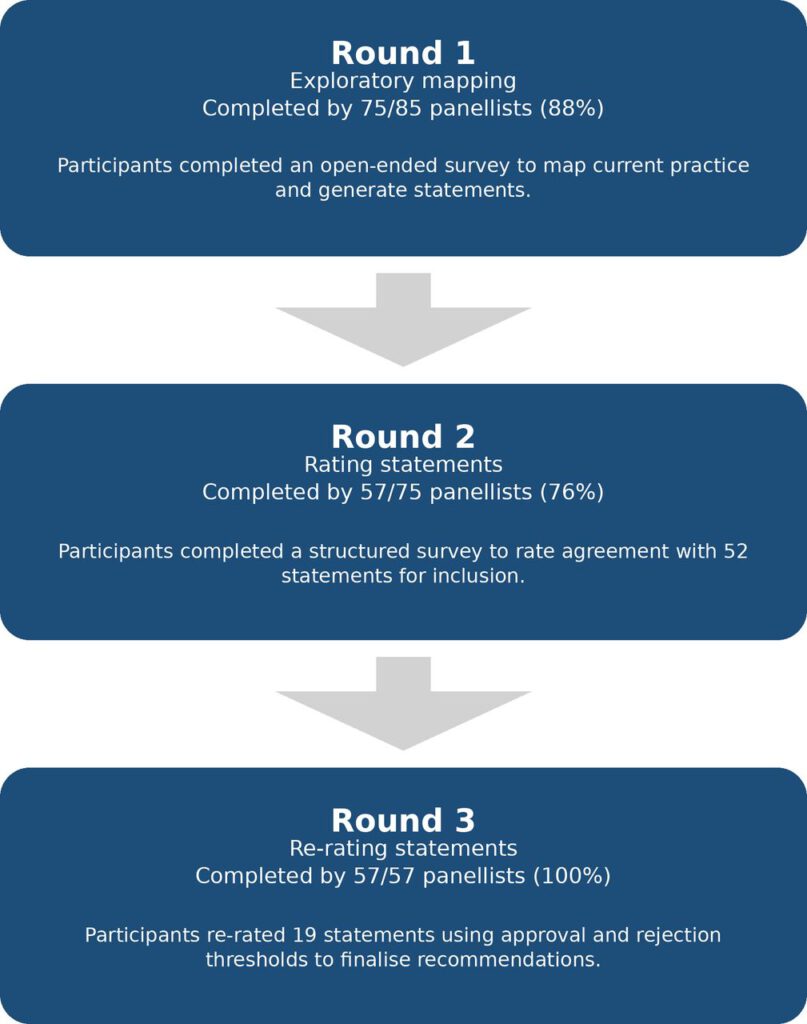
Design: A three-round Delphi study conducted online. Round 1 used open-ended questions to map current practice and inform statement development; Round 2 rated 52 statements on a 5-point Likert scale with an a priori approval threshold of ≥80% agreement (agree/strongly agree); Round 3 rerated 19 statements using approval (≥80% agree/strongly agree) and rejection (≥80% disagree/strongly disagree) thresholds.
Setting: Virtual (online survey platform).
Participants: An international, multidisciplinary expert panel recruited via relevant SP networks and targeted invitations, including researchers, healthcare professionals, link workers and implementation stakeholders in accordance with the published study protocol.
Results: Round 1 was completed by 75/85 invited panellists (88%). In Round 2, 57/75 (76%) rated 52 statements across six domains; 19/52 met the ≥80% agreement threshold, with strongest consensus for core SPLW functions (navigation, advocacy, follow-up and documentation) and for support needs (mandatory communication/navigation training and supervision). Round 3 was completed by 57/57 (100%) and approved 13/19 rerated statements, extending consensus to include data collection with appropriate safeguards, optional accompaniment to community activities, limited first-step support for urgent social problems, context-sensitive funding principles, a cofunded employment model, multiple access routes (including telephone/in-person/online), self-referral and secondary-care referral, and the use of digital tools as complements rather than substitutes for relational support.
Conclusion: Across three Delphi rounds, the panel converged on actionable, consensus-based recommendations for SPLW practice and for accessible, context-adaptable implementation.